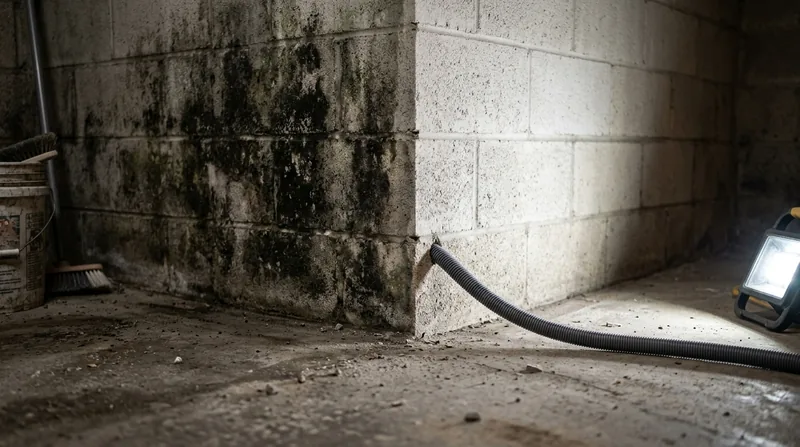




Basement Mold Remediation in Murfreesboro: Fix the Moisture, Not Just the Mold
If you are searching for Basement Mold Remediation in Murfreesboro, the musty smell you noticed near the stairs and the fuzzy dark patches on the block wall are the same problem wearing two faces. The Nashville Basin limestone under this city sits beneath a thick layer of cherty clay residuum that holds water like a sponge, swells in wet weather, and pushes that moisture against foundation walls. Most homes here are slab-on-grade, but the older brick and frame houses around the Downtown Square and off Cason Lane often sit on partial basements behind stone and block walls that have been wicking water for decades. In the 1950s to 1970s ranches along Jefferson Pike and Lascassas Pike, a damp lower level after a summer storm is usually a drainage issue, not a cleaning issue. We treat the mold and then we stop the water that feeds it, because remediation without moisture control is a callback waiting to happen. Start with a look at our basement waterproofing service to see how the water side of the job works.
Why Basement Mold Grows So Fast in Murfreesboro Homes
Mold needs three things: a food source, warmth, and moisture. Murfreesboro gives it all three. The humid summers and mild winters keep foundation soil wet for long stretches, and heavy storms drop rain in short bursts that overwhelm grading and downspouts. When that water reaches the footing, hydrostatic pressure forces it through block joints and hairline cracks, and the basement stays at 60 to 70 percent relative humidity even when the floor looks dry. Add the paper facing on old insulation or the wood framing of a 1950s ranch and you have a food source. The mold shows up on the lower courses of the wall, behind stored boxes, and along the baseboard where the slab meets the block.
- Efflorescence, the white chalky powder on block walls, tells you water is moving through the masonry right now.
- A musty smell that gets stronger after rain points to active seepage rather than an old, dried-out stain.
- Peeling paint or soft drywall near the floor means moisture has been wicking up for more than one season.
- Rust on the bottom of a furnace or water heater is a reliable sign the basement floor has been wet.
- Mold that returns within weeks of cleaning means the moisture source was never addressed.
Every one of those signs points back to the same fix: control the water, then remediate the surfaces it damaged.
Key info: On the older blocks off Cason Lane, we routinely find mold growing on the back of paneling where a stone foundation wall has been seeping for years. The paneling looks fine from the room side. The moisture reading tells the real story.
For the permit side of any structural work that comes out of an inspection, the City of Murfreesboro Building and Codes Department is the authority to check with, since requirements vary by scope and jurisdiction: City of Murfreesboro official site.
How We Run a Basement Mold Remediation Job in Murfreesboro
We do not fog a basement and hand you a bill. The job starts with finding out why the space is wet, because the remediation plan depends entirely on that answer. A wall that seeps after every storm needs a different fix than a floor that stays damp because the humidity never drops. We work in a set sequence so nothing gets recontaminated and nothing gets covered up.
- We inspect the basement and the exterior grade, then take moisture readings on walls, floor, and framing to map where the water is coming from.
- We set up containment with plastic sheeting and negative air pressure so spores do not spread into the living space above.
- We remove porous materials that cannot be cleaned, such as wet drywall, insulation, and cardboard, and bag them for disposal.
- We treat affected surfaces with an approved antimicrobial and HEPA-vacuum the entire area, including joists and the tops of walls.
- We correct the moisture source, whether that means sealing cracks, extending downspouts, or installing drainage and a dehumidifier.
- We verify with moisture meters and a visual clearance check before we call the job done.
The last step is the one that matters most, because a basement that stays dry does not grow mold again.
Key info: A homeowner near Veterans Parkway called us after a sump pump failed during a July downpour. The carpet was wet for three days and the baseboard mold was already visible. We pulled the wet materials, treated the framing, and replaced the pump with a unit on a battery backup so the next outage does not repeat the cycle.
If the inspection shows the water is coming through the wall rather than the floor, the right next step is often foundation crack repair with epoxy or polyurethane injection before any surface treatment goes back on.
Remediation Approaches We Use in Murfreesboro Basements
Not every mold job is the same size, and not every moisture source calls for the same fix. The table below shows the approaches we use most often in this market and when each one is the right call. We pick the method after the inspection, not before.
| Approach | Description | Best for |
|---|---|---|
| Surface treatment and HEPA cleaning | Antimicrobial treatment of block and framing, followed by HEPA vacuuming of all surfaces. | Small patches of mold on masonry where the moisture source is already fixed. |
| Containment and material removal | Sealed plastic containment, negative air pressure, and removal of wet drywall, insulation, and porous goods. | Larger growth areas, or any job where drywall and framing are both affected. |
| Drainage correction | Interior perimeter drain, sump basin, and discharge line to move water away from the footing. | Basements that seep at the wall-floor joint after every heavy storm. |
| Crack injection and wall sealing | Epoxy or polyurethane injection into cracks, plus a waterproof membrane or parging on the wall face. | Isolated cracks and porous block walls where hydrostatic pressure is moderate. |
| Humidity control | Dehumidifier sizing and vapor barrier placement to keep the space below the threshold where mold grows. | Basements that stay damp without visible seepage, common in humid Murfreesboro summers. |
Most jobs combine two or three of these, because the mold and the moisture rarely come from a single cause.
Basement Mold Remediation Cost in Murfreesboro: What to Expect
Remediation pricing starts at from $1,500 for a contained job with surface treatment and HEPA cleaning in a single basement room. From there, the number moves with square footage affected, how much porous material has to come out, and whether the moisture fix is included. A job that also needs drainage correction or crack injection will land higher, because you are paying for two scopes of work that solve two different problems.
- The size of the affected area is the single biggest driver, since containment and cleaning labor scale with square footage.
- Material removal adds cost when wet drywall, insulation, or stored goods have to be bagged and hauled out.
- Access matters: a narrow basement stair in an older Downtown Square home slows the work compared with a walkout on a sloped lot.
- Whether the moisture source is corrected in the same visit changes the total, and skipping it usually costs more later.
- Emergency response after a storm or a sump pump failure carries a premium over a scheduled job.
Get two or three written estimates and compare scope line by line, not just the bottom number. You can see how we structure pricing on our pricing overview.
Basement Mold Remediation Near Me: How to Vet a Contractor Near Murfreesboro
Anybody with a sprayer and a truck can call themselves a mold remediator. The difference shows up six months later, when the smell comes back or the framing was never actually dried. Ask direct questions before you sign anything, and do not accept a verbal answer on insurance or licensing.
- Confirm the company is licensed and insured, and ask for a certificate of insurance to be sent before work starts.
- Get at least two or three estimates in writing so you can compare what each one actually includes.
- Ask for local references from jobs in Murfreesboro, Smyrna, or La Vergne and call them.
- Ask whether the moisture source will be corrected in the same scope, because remediation alone is a temporary fix.
- Check whether any structural or drainage work requires a permit from the local building department, since thresholds vary.
- If you are in an HOA, confirm any exterior drainage changes meet the association rules before scheduling.
If a contractor cannot answer those questions clearly, keep looking. You can reach us through our contact page when you are ready to schedule an inspection.
Basement Mold Remediation in Murfreesboro: Pricing Guide
| Service | Price | Details |
|---|---|---|
| Single-room surface treatment | Starting at $1,500 | Containment, antimicrobial treatment, and HEPA cleaning for one affected basement room. |
| Multi-room remediation with material removal | Starting at $2,800 | Includes removal of wet drywall and insulation, with cost driven by square footage affected. |
| Remediation plus moisture correction | Starting at $4,500 | Combines treatment with crack injection or drainage work so the moisture source is actually fixed. |
| Emergency response after flooding | On estimate | Same-week response after a storm or sump pump failure, priced after an on-site look. |
| Travel | Included | In Murfreesboro and surrounding areas, no separate call-out or mileage fee. |
| Estimate | Free | Response within 24h at (629) 238-0863, no obligation to book. |
Indicative pricing, the exact cost depends on square footage, finish, and site access. Free personalized estimate within 24h at (629) 238-0863.


