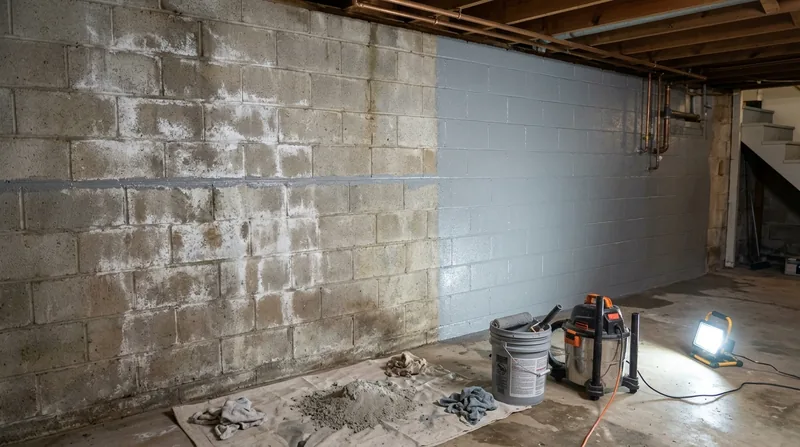




Murfreesboro sits on a thick layer of cherty clay residuum over Nashville Basin limestone, and that ground holds water the way a sponge holds a spill. Around the Downtown Square and the older blocks off Cason Lane, 1900s brick and frame homes often sit on partial basements behind stone and block walls that weep after every hard storm. Out along Barfield and the Veterans Parkway corridors, 1990s and later brick subdivisions are mostly slab-on-grade, so when a homeowner calls us about a wet basement, the answer is usually Basement Wall Sealing in Murfreesboro paired with a real diagnosis of where the water is coming from. We prep the wall, strip the efflorescence, and apply a penetrating or membrane sealer built for below-grade masonry. We also tell you plainly when a sealer is the wrong tool and hydrostatic pressure is the real problem. Start with a free basement inspection and we will show you what the wall is actually doing.
Why Basement Wall Sealing Matters on Murfreesboro's Clay and Limestone
The failure mode that dominates here is not a crack in the middle of a wall. It is damp masonry, white salt bloom, and slow seepage pushed by a water table that rises fast during short, heavy summer storms. That clay residuum swells when it wets and cracks when it dries, and it pins water against the wall instead of letting it drain down to the footing. Sealing is the right first move on walls that are damp but not actively leaking under pressure.
- Efflorescence removal clears the salt bloom so the sealer can actually bond to the masonry.
- Penetrating sealers react inside the pores of block and brick and leave the wall able to breathe.
- Membrane sealers build a flexible film on the face of the wall and bridge hairline checks.
- Parging repairs minor surface loss before any coating goes on.
If the wall is wet to the touch at the base after a storm, sealing alone will not hold it, and we will say so before you spend the money.
Key info: A 1950s brick ranch off Lascassas Pike with a partial basement and white bloom on the block is a textbook sealing job. A home on low ground near the Stones River with water standing at the wall base after every May storm needs drainage first, not a coating.
For the official word on what work needs a permit in this jurisdiction, check the City of Murfreesboro building department before any structural or drainage alteration.
How We Seal a Basement Wall in Murfreesboro, Step by Step
We do not sell a coating on the first visit. We walk the wall, read the moisture, check the grading and downspout extensions outside, and look at the footing drain if it is accessible. Then we choose the sealer and the prep that fits the wall you actually have, whether that is block, poured concrete, or old stone.
- We inspect the wall and map where moisture is entering, including the cold joint at the floor.
- We remove efflorescence and loose parging with a wire brush and a masonry cleaner.
- We fill non-structural holes and patch surface defects with a hydraulic mortar.
- We apply the penetrating or membrane sealer in the coats the product calls for.
- We correct grading and extend downspouts so roof water lands away from the wall.
If the inspection shows active hydrostatic pressure, we tell you that an interior drain tile system is the better answer and we quote it honestly.
Key info: On a 1970s brick ranch near Jefferson Pike, the wall was damp but dry at the floor. Sealing plus downspout extensions solved it. Two streets over, the same-looking wall had water pushing at the base, and that homeowner needed drain tile, not a sealer.
Sealing Approaches We Use and When Each One Fits
Not every wall takes the same product. Block, poured concrete, and old stone behave differently, and the moisture reading decides which approach we recommend. Here is how the methods compare on a typical Murfreesboro basement wall.
| Approach | Description | Best for |
|---|---|---|
| Penetrating sealer | Reacts inside the pores of block and brick and leaves the wall breathable. | Damp block walls with light efflorescence and no standing water. |
| Membrane sealer | Builds a flexible film on the wall face and bridges hairline checks. | Poured walls with fine surface cracking and damp patches. |
| Parging and sealer | Repairs surface loss with hydraulic mortar before the coating goes on. | Older stone and block walls with spalling or crumbling mortar. |
| Crack injection plus sealer | Epoxy or polyurethane injection closes the crack, then the wall is sealed. | Walls with a defined crack that seeps after rain. |
| Drainage first | Interior perimeter drain and sump relieve pressure before any sealer. | Walls wet at the base under hydrostatic pressure. |
The table is a guide, not a decision. The moisture reading and the grading outside decide the recommendation.
Basement Wall Sealing Cost in Murfreesboro: What to Expect
Most sealing work in this market starts around $1,500, and that figure covers a typical partial basement wall with prep, efflorescence removal, and two coats of sealer. The number moves with wall length, wall material, how much parging repair is needed, and whether crack injection is part of the job. Access matters too: a wall behind shelving and a finished ceiling takes longer than a bare wall.
We quote after we see the wall, not over the phone, because a damp block wall and a wall under pressure look identical in a photo. Get two or three estimates and ask each contractor what they found for moisture and what they would do if the sealer does not hold. Our full pricing overview lays out the ranges so you can compare apples to apples.
Hiring a Basement Wall Sealing Contractor Near Murfreesboro
Ask for the license and insurance certificate before anyone touches the wall, and confirm the coverage is current. Ask for references from jobs in Murfreesboro or the surrounding towns, not from out of state. Ask whether the work needs a permit, and check with the local building department if the scope includes structural repair or drainage changes. If you live in a subdivision with an HOA, confirm any exterior drainage changes are allowed before work starts.
Then compare the diagnoses, not just the prices. A contractor who tells you sealing is enough when it is, and tells you when it is not, is the one to hire. Reach us through the contact page and we will set up the inspection.
Basement Wall Sealing Near Me: What Murfreesboro Homeowners Should Know
When you search for basement wall sealing near me, you will find coatings sold as a cure-all. They are not. A sealer manages dampness and stops surface dusting, but it cannot hold back a rising water table, and it will not fix a wall that is bowing. If you see horizontal cracks or a wall leaning in, that is a structural conversation, and we will point you to the right repair rather than sell you a coating.
We serve homeowners across the Murfreesboro area, including La Vergne, Smyrna, and Eagleville, and we bring the same honest read to every wall. Call (629) 238-0863 and we will tell you what your wall needs.
Basement Wall Sealing in Murfreesboro: Pricing Guide
| Service | Price | Details |
|---|---|---|
| Penetrating sealer on a partial basement wall | Starting at $1,500 | Includes efflorescence removal, surface prep, and two coats on a typical wall. |
| Membrane sealer with minor parging repair | Starting at $1,900 | Adds hydraulic mortar patching where the wall face has spalled or crumbled. |
| Crack injection plus wall sealing | Starting at $2,400 | Epoxy or polyurethane injection closes a seeping crack before the sealer goes on. |
| Drainage-first assessment and sealing | On estimate | Needs an on-site moisture and grading read before any number is given. |
| Travel | Included | In Murfreesboro and surrounding areas, no separate call-out or mileage fee. |
| Estimate | Free | Response within 24h at (629) 238-0863, no obligation to book. |
Indicative pricing, the exact cost depends on square footage, finish, and site access. Free personalized estimate within 24h at (629) 238-0863.


